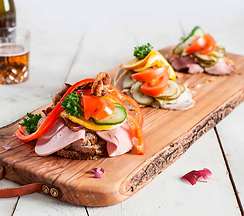
Smørrebrød: The Core of Danish “Hygge”
Sophia Luise Dahl

(Meny.dk)
In Denmark, Smørrebrød is everything. It's the lunch your mom packed for you for school as a child. It is the festive lunch your grandmother makes for the whole family during Christmas and easter. It’s the night-snack you make for yourself in the kitchen at 3 am after a night out with friends. It’s the cheap dinner you make at the end of the month when the funds are low. It’s the most expensive dish at a fancy modern restaurant.
Okay, but what is Smørrebrød really? To explain it simply: smørrebrød – literally meaning buttered bread – is a piece of dense, dark rye bread that is topped with neat layers of meat and garnishes. Classically served with local beer and snaps (a liquor distilled from grain flavored with herbs).
(Slagterjensen.dk)
Smørrebrød is very traditional in the sense that there exists a whole unwritten book of rules on how to combine the layers of toppings. The different bread and topping combinations all have different names - many of them quite quirky. For example “The Veterinarian’s Night Food,” “Shooting Star” or “Sun over God's Home”.
Foreigners will experience ridicule and judgy side-eyes, when they at a Danish lunch table make the grave mistake of putting mayonnaise on top of a slice of fried fish (the Danish relish remoulade is the only correct option obviously).
Smørrebrød has been an integral part of Danish culture for hundreds of years and is even a popular motive in paintings. But what about today? Where does the tradition of smørrebrød stand?
(P.S Krøyer, Four children having lunch, 1887)
At a cafe in central Copenhagen, chef Lo Østergaard has created the smørrebrød-sushi hybrid: smushi. “We traveled to the other side of the world to get inspiration and found sushi,” Østergaard explains. At Smushi, traditional smørrebrød is delicately presented in the style of Japanese sushi. Smushi is a good example of how smørrebrød, like many other traditional dishes, is reinvented and reinterpreted in a modern globalized world.
(mitziemee.com)
Personally, some of my fondest memories are of eating smørrebrød with family and friends during festive lunch-parties. In Danish culture, celebratory occasions, such as Christmas, Easter, and personal achievements, are traditionally celebrated with a long lunch-party, where smørrebrød is the main event. These lunches are a long affair often taking place from early noon to late in the evening. In Danish culture, the tradition of smørrebrød extends in that way beyond a simple meal; it embodies the Danish concept of “hygge”. A way of life centered around relaxation, socializing, and savoring the moment.
(blog.dinnerbooking.com)